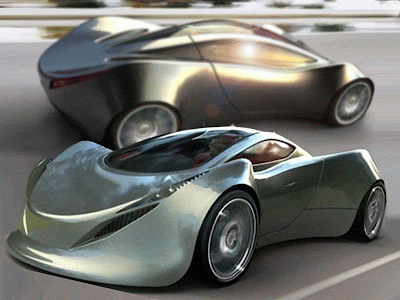
Opel Ampera
Unless you’ve been living in a cave on the Moon with your eyes shut and hands over your ears, you know that electric vehicles are the future. Not a week goes by where there isn’t some announcement about the car that will break the ties of petroleum oppression. For you, dear readers, I have assembled a list of some of the more notable entrants into the EV market with the pros and cons of each. From econoboxes to SUVs, grocery getters to exotics. Enjoy.
Mini E

The Mini E is for people that stay close to home and shop one grocery bag at a time. It looks like any other Cooper and handles as well too. Power comes from 5088 lithium-ion battery cells and the range is up to 100 miles (if you’re lucky). Non-Cooperists will hate the lack of back seat and storage in an already small car. 450 Mini E’s will be piloted for the ludicrous price of $850 per month.
Pros: Responsive steering, all the amenities of a standard Mini
Cons: No range extender, storage capacity is more micro than mini
Status: Currently a pilot project, production in 2013
Verdict: Needs a smaller battery pack and range extender
Dodge Circuit EV

Looking to compete with Tesla, Dodge has also gone the Lotus route and electrified the Europa. Zero to sixty is under five seconds and the total range is a respectable 150 miles. Storage is nil, but at $85,000 this is no one’s only car. As the same powertrain is spread across multiple variants, expect to see a price drop within a few short years.
Pros: Excellent acceleration, Lotus handling
Cons: 600 lb battery throws it off balance
Status: Prototype testing
Verdict: Buy a Circuit and a hauler for the price of a Tesla roadster
Chevrolet Volt (also Opel Ampera)

Never heard of it. I understand it has an electric range of 40 miles and a 1.4-liter range-extending ICE acting as a generator. Most importantly, it will seat four full-size adults. Trunk space is also retained thanks to the T-shaped battery pack mounted under the rear seats. It should list for $40,000 with a $7,500 tax credit.
Pros: Plenty of tech, plenty of space, reasonable price
Cons: Low range, anemic performance once range extender kicks in
Status: on sale November 2010
Verdict: Has been and will be the benchmark for years to come
Toyota Prius Plug-in

People have been modifying the Prius for years to eke out every last mile, but Toyota will finally produce an all-electric version of the hybrid icon in 2012. First-year output will be between 20,000 and 30,000 cars and price may be around $47,000. They had better fix one thing for sure, and that’s the estimated 12-18 mile range. WHAT!? [Reuters]
Pros: Proven technology, familiar package, solid reliability
Cons: Lack of performance handling, very little “fun factor”
Status: Available in 2012
Verdict: Unless the price and/or performance drastically improve, get in line for a Volt
Silence PT2

In February of 2006, electric motor manufacturer EBW partnered up with bad ass three-wheeler T-Rex to create a fun, fast, and compact electric vehicle priced at $43,000. Range is approximately 125 to 250 miles per charge and the top speed it 125 mph. The price seems a little high for what you’re getting, but think of all the fun you can have in what amounts to an electric motorcycle for two.
Pros: Extremely sporty and fun to drive
Cons: Virtually no storage and a price similar to some EV sedans
Status: Available now, it seems, but the website doesn’t instill confidence
Verdict: Strictly a toy for someone with multiple cars
Fisker Karma

Car designer and coachbuilder Henrik Fisker partnered with Quantum Technologies in 2007 to design and build the Karma. Think of it as the same range-extending technology as a Chevy Volt with twice the horsepower. What makes Fisker special are his production methods. He keeps a small crew of engineers and outsources nearly every aspect of the car to various suppliers. The result is lightning-fast development at a fraction of the cost of larger manufacturers.
Pros: Ridiculously cool styling, high performance, luxurious, great price at $87K
Cons: Feels rushed to market, price seems too good to be true
Status: Production scheduled for the end of 2009, deliveries in Q1 2010
Verdict: If the Karma turns out not to be vaporware, it could blow everything else out of the water
Cadillac Converj

Cadillac’s version of the Chevy Volt in coupe form. Expensive battery packs mean high-priced electric cars, but the luxurious Converj will seem reasonable if GM can keep it under $70K.
Pros: Aggressive styling, magnetic ride control, all the best tech
Cons: Similar performance to the Volt at a higher price, only two doors
Status: Green light
Verdict: Awesome, but there better be a sedan in the works too
Chrysler ENVI Town & Country/Jeep Wrangler Unlimited EV

Chrysler is not stopping with just the Circuit EV. The same battery pack can easily be dropped into multiple platforms including the mom-friendly Town & Country and various Jeep products. Expect the same 150-mile limit per charge. I feel they really hit the nail on the head here, developing multiple EV platforms at once. Will Chrysler be the first to offer an all-electric line?
Pros: Same performance in different packages provides more options
Cons: Still no range extender
Status: Prototype
Verdict: This costly gamble just may save Chrysler from irrelevance
Nissan EV

Nissan is currently undergoing testing for their new EV using first-generation Cube mules. The final product will be closer to a Sentra, and hopefully nowhere near the Mixim EV concept pointed out by Geoff. From stage one, Nissan recognized the futility of a $50K electric econobox. The ultimate goal is a price between $25-33,000. Stats are on the high-end of the EV scale too, 100 miles on a 40 minute charge.
Pros: May be the first EV from a major player to break the $30K barrier
Cons: It’ll be a little late to the party, but that’s it
Status: Production beginning in 2011
Verdict: If you can stay off the bandwagon for long enough, the Nissan may be the best value out there
SSC Aero EV

With a 0-60 time of 2.5 seconds, you would think the Shelby Aero EV was burning rocket fuel, not petrol. The answer is neither. The 1,000 hp superEV (TM) is powered by an All-Electric Scalable Powertrain good for up to 200 miles between charges. The recharge time is practically unbelievable at 10 minutes, compared to 3 hours on the Tesla Roadster. Something tells me you can’t have your cake and eat it too with the acceleration and range.
Pros: Incredible range, performance and refueling time, BONUS: the cops will never hear you coming
Cons: Interestingly, the price is probably only for those who have all the oil they want
Status: Production beginning in late 2009
Verdict: If money were no object, it would be perfect
Tesla Roadster

This is the trailblazer. Sure, Tesla didn’t invent the electric car or even put one on the road first, but the Roadster proves than an independent electric car company with a good idea and lots of financing can indeed make a name for themselves. Built on a Lotus Elise platform, the $100K Roadster will exceed 200 miles on a single charge and accelerate from 0 to 60 in under 4 seconds.
Pros: Exhilarating performance, one of few convertible EVs
Cons: Price, availability, lack of dealer network
Status: Available now, sort of
Verdict: A good car, but you’re late to this party. 300 cars delivered and over 1,000 customers waiting
Tesla Model S

Where the Tesla Roadster was sort of a proof-of-concept initiative, the Model S is CEO Elon Musk’s mass market savior. He’ll try and tell you it seats seven and can store a 50-inch TV, mountain bike and a surfboard all at the same time. He’ll say it will go at least 160 miles on a charge and produce 400hp. He’ll boast about the 17-inch touch screen with 3G connectivity inside and the sub $50K price tag. I say let’s slow the hype train a little bit.
Pros: In addition to everything above, it’s designed by Franz von Holzhausen (Solstice/Sky)
Cons: Remember, the first Roadsters were delivered late and with temporary transmissions
Status: Available in 2011
Verdict: For all his talk, what Musk does have that other’s don’t is cars on the road.
Chrysler 200C EV

You didn’t think Chrysler was working on all these EVs only to leave out the sedan, did you? The 200C has a striking new look for Chrysler, and the interior is clearly conceptual. Using the same powertrain as the rest of the line, it can travel up to 40 miles using only battery power and up to 400 miles without refueling. Pricing and availability are unreleased at this time.
Pros: Beautiful style at what will probably be a reasonable price
Cons: None yet, just Chrysler’s viability
Status: Concept (will likely see production soon)
Verdict: If priced properly, this could by Chrysler’s “Volt-like” savior
Chrysler GEM Peapod

Have you ever seen something just too cute for this world? And that meant you had to kill it? Introducing the GEM Peapod by Chrysler. This ultra-compact EV is the first vehicle of its kind for GEM, having normally focused on open-top golf cart-style vehicles. It is available in two-, four- and six-passenger configurations. As Vito noted, the downfall will be the performance. 30 miles per charge and a top speed of 25 mph.
Pros: It may attract cute chicks as would walking a puppy
Cons: It will attract assholes that’ll throw rocks at you
Status: Available now
Verdict: Sure it’s cute like the Stay Puft Marshmallow Man but seriously, $20,000?
Raser Technologies HUMMER H3

If you’re a big fan of irony, the Raser H3 EV is for you. Using an E-REV powertrain similar to the Volt, you can curse all the wasteful Prius owners you like. Raser Technologies developed the 200 kW motor and 100 kW generator to stretch as much as 400 miles on one tank of gas. The first 40 miles are all electric, then the generator sips gas to keep you going. For those that average 50 miles per day, the Raser H3 averages 165 mpg.
Pros: Raser was very specific that off-road capabilities not be compromised
Cons: If you actually drive it like a HUMMER, expect those MPGs to drop
Status: Prototype
Verdict: I know the thing works, I just can’t find any info on how the hell to get one
eRUF Model A

The Legendary Porsche tuners at RUF have gone and done the unthinkable by electrifying a Porsche 911. Though the purists will likely cry blasphemy, it’s hard to ignore the cool factor. The battery pack takes a full 10 hours to charge and provides a maximum range of 200 miles. With the equivalent of 204 horsepower, performance is good but not great. The 0-60 is less than 7 seconds and the top speed is 160 mph. But watch out RUF, apparently Porsche is working on their own version.
Pros: Strong performance, classic styling
Cons: Charge time, price over $200,000
Status: Available to order
Verdict: Too expensive considering the technology, it’s not an electric GT2 after all
Volvo Plug-in Diesel Hybrid

I tend to agree with Alex on this one. Throwing some graphics on a Volvo and photoshopping it next to a “charging station” doesn’t say anything. You’ll have to do better to get even resident fangirl Suzanne’s money. Volvo President and CEO Stephen Odell says it all: “In fact, I would go so far as to say that the plug-in electrical hybrid we will launch in 2012 will be a true dream car. With the innovative solution we will offer, the car owner will be able to drive a thoroughly enjoyable car packed with Volvo’s renowned high safety and genuine driving pleasure.” A generic statement about a car that doesnt’ exist if I’ve ever heard one.
Pros: Knowing Volvo, they’ll take the time to get it right and it will be the safest EV on the market
Cons: Platform hasn’t even been decided, though Volvo hints at C30, S40 and V50
Status: The Volvo TBD will be available TBD with a price of $TBD and a range of TBD miles
Verdict: You can trade in your first EV for one
Coda Electric Sedan

Miles Rubin, founder of Miles EV, has created Coda Automotive to build his first full-size electric passenger car. Miles EV specializes in smaller city cars, so production will be outsourced to Chinese firm Hafei Automotive and based on their existing Saibo sedan. It’ll sport average stats of 90 to 120 miles on a charge and a 0 to 60 of about 11 seconds. Price is estimated at $45,000. [
Pros: For those that like to blend in, a completely generic looking EV that no one has ever heard of
Cons: Chinese knockoff of existing technology, what could go wrong?
Status: 2,700 built next year for Californians, full rollout in 2012
Verdict: Proceed with caution
Mitsubishi i-MiEV

Mitsubishi has managed to shove their MiEV system into the tiny “i” city car. Of course, Alex points out that it could be just in name only. The battery-only range of 100 miles gets an A+ and the quick 30 minute charge time is excellent as well. What hurts is the $50,000 price tag. So close, Mitsu! The 62 hp it produces won’t shred any tires, but I can see this thing spank the Smart if the price came down a little.
Pros: Better range and charge time than most EVs
Cons: Price, and my lawnmower puts out more horses
Status: Worldwide sale in 2010
Verdict: Great for city dwellers only
Koenigsegg Quant

The Koenigsegg Quant started off as a concept resulting from the collaborative efforts of NLV Solar AG and supercar manufacturer Koenigsegg. The electric-only range is 500 kilometers and the charge time flies by in 20 minutes. The best part is the thin layer of photovoltaic panels which cover the car and help feed the batteries. Since we reported that the Quant might see production (and since I’ve started writing this article), Koenigsegg has released a statement clarifying that the Quant was strictly a concept and never meant for production.
Pros: The most wicked styling and performance of any EV
Cons: What does it cost to touch up a car layered with photovoltaic cells?
Status: Nixed by the ‘Segg
Verdict: I can see it happening someday, and when it does, you still can’t afford it
Exxon-Mobil/Electrovaya Maya 300

The oil companies want to sell me an electric car. Be suspicious. For now this is a joint venture to inform the public on the benefits of EVs, but future production is not out of the question. Baltimore residents may rent the Maya 300 through the Maryland Science Center’s Altcar program.
Pros: 60-120 mile range per charge from standard outlet
Cons: Limited availability, radio may play anti-EV subliminal messages
Status: Sorry, Baltimorians only for now but may be available in 2011
Verdict: If it does hit someday at the target price of $25,000 I could possibly justify buying what looks like an electric Nano
South Park’s “IT”

The “IT” was developed in South Park, Colorado by one Mr. Garrison. Tired of being hassled by the airline companies, Mr. Garrison leveraged his experience as an elementary school teacher and his knowledge of quantum physics to create a unique form of transportation. Its propulsion methods are top secret and known only to lead designer, Mr. Hat. The “IT” uses no fuel, but trust me, it’ll cost you.




 Electric Powered Cars
 Electric Cars for sale
 New Electric Cars
 Electric Cars Tango
 Electric Cars New Generation
 Electric Cars
 On Friday, the company Renault has confirmed its plans for mass production of two electric vehicles, built on the explanation of the concept cars ultra Twizy ZE and a small compartment Zoe ZE, tells the magazine Autocar. Production of the first one in 2011, will be established at the Spanish plant in the city of Valladolid, and the second - in France, a year later.It is expected that the French Renault factory in the town of Flaine become a kind of center for the development programs of the company to produce to the market of compact electric - at this facility will meet the key models of electric vehicles, as well as to production and processing of batteries used in the propulsion machinery. In "Reno" suggest that the model Zoe will have two-thirds of the total European sales of electric vehicles.As previously reported, the concept car Renault Zoe ZE equipped with 95-horsepower electric motor, receiving energy from lithium-ion batteries. These batteries provide a vehicle movement over 160 kilometers, and their charge from household electrical outlet will take from four to eight hours. Compact car Twizy ZE were equipped electric power of 20 horsepower and can travel without recharging about 100 kilometers. Maximum speed of the prototype was 75 kilometers per hour.
 We note that on Friday, the alliance Renault-Nissan has also negotiated with the Atomic Energy Commission and the Strategic Investment Fund, the French agreement of intent to establish a joint venture that will investigate, the transfer of industrial production and recycling of batteries for electric vehicles. Renault plans to produce batteries at plants in France, Britain and Portugal.